
Despite Promises for Change, Still No Accountability for MST
Recent statements made to the press by the San Diego City Attorney’s Office and Navy officials illustrate that despite promises to the contrary, there is no real effort being made to stop Military Sexual Trauma (MST).
I help run Veteran Sisters, a non-profit organization that supports and advocates for Military Sexual Trauma (MST) survivors. We are a peer-to-peer organization made up primarily of female Veterans. As one of the few members to make it all the way through the criminal justice system for my own sexual assault, I am often called upon as a Victim Advocate for our members.
MST is the term used by the VA to refer to experiences of sexual assault or repeated, threatening sexual harassment that a Veteran experienced during military service. MST encompasses any sexual harassment or sexual activity a service member endures without providing consent.
Although about one out of every four female Veterans reports MST while on active duty, the numbers are thought to be much higher. Victims cite several reasons, including fear of reprisal and command climate, for not speaking up.
It is incredibly difficult to encourage victims of sexual violence to report assault when authorities take no action. More than a year ago, the brutal murder of U.S. Army Spc. Vanessa Guillén, after her reports of sexual harassment were ignored by leadership, put MST into the spotlight, and as Army Gen. Mark Milley, chairman Joint Chiefs of Staff, said last week, “People like me keep going behind a microphone in front of committees saying, ‘We need to do this and we need to do that, we need to this and that,’ and it hasn't changed.”
THE INCIDENT
In October 2020, I was called upon to perform the duties of a victim advocate for a close friend.
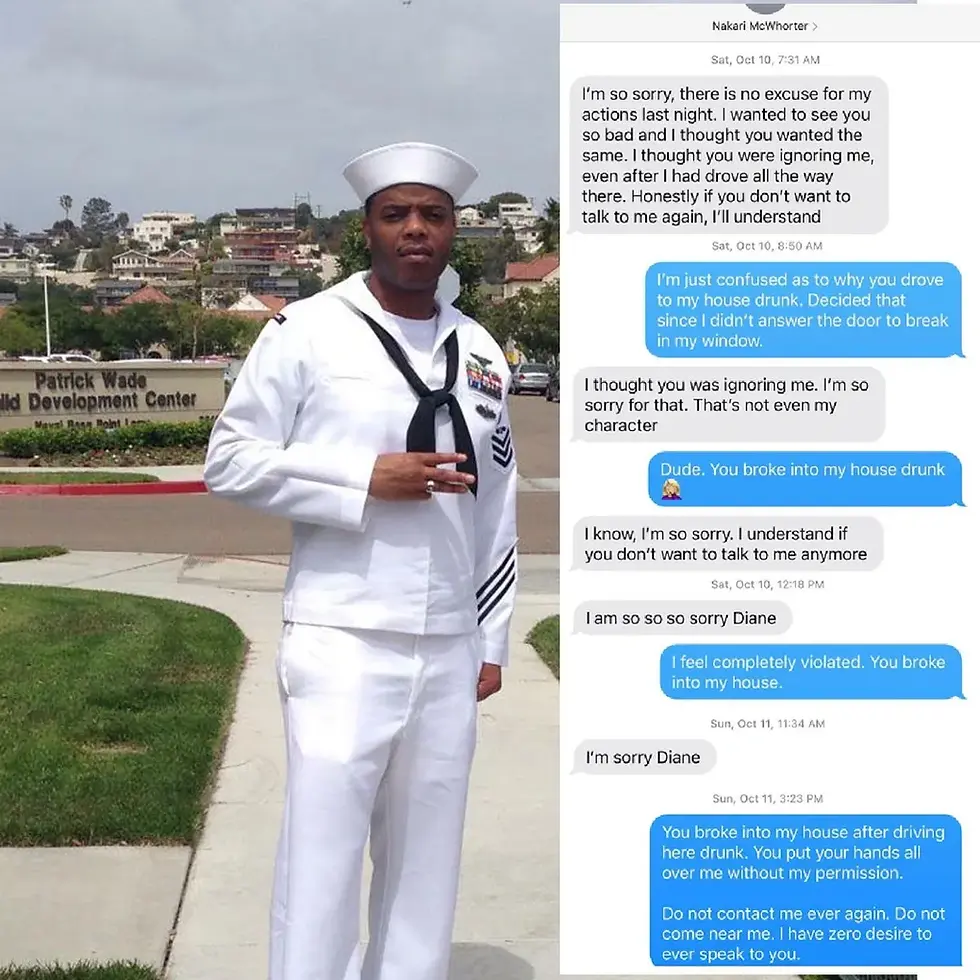
According to the victim, Diane Porter, active-duty Navy Chief Petty Officer Nakari McWhorter, assigned to recruiting duty in San Diego, broke into her home while intoxicated and spent nearly half an hour terrorizing her before she convinced him to leave.
He left visible fingerprints and a container with alcohol residue on the lawn and the next morning he sent several text messages apologizing for his actions. Statements included “I’m so sorry, there is no excuse for my actions last night.” and “Honestly, if you don’t want to talk to me again, I’ll understand.”
I was present when the San Diego Police Department (SDPD) detective assigned to investigate, laughed at Diane when she asked him to dust for fingerprints and take the container as evidence and said he didn’t need to because there was no doubt McWhorter broke into her house.
RESPONSE BY AUTHORITIES
As a 20-year Navy Veteran with a stellar career, who spent six years on special duty assignments transforming civilians from all walks of life into Navy Sailors and just spent months listening to military leaders and politicians make promises to stop MST, Diane had complete confidence that the Navy would take her report seriously.
Instead, the Navy’s response seemed to be the complete opposite of the recent promises. It took days and two e-mails and a copy of the civilian temporary restraining order before San Diego Recruiting Command’s leadership responded to the victim’s reports of breaking and entering and sexual assault by a senior member of the recruiting command.
Once contact was made, she immediately provided his command and NCIS with copies of all the evidence she shared with SDPD and the City Attorney’s Office. At the victim’s request, because I work daily with MST survivors; I shared with the command’s executive officer that McWhorter’s behavior led me to believe that he likely had other victims because research shows that perpetrators of sexual crimes typically re-offend and become increasingly emboldened, the longer they get away with it.
I asked that the command remove McWhorter from his position of public trust while they investigate his conduct with the women under his charge while on special duty as a recruiter, because his unsupervised access to a historically vulnerable group was a huge red flag.
Despite this information and the text message confession to his actions, McWhorter continued to have unfettered access to young women enlisting to serve our nation for a further 23 days. His reduction in duties coincided with media queries made as to his duty status.
In a statement to Andrew Dyer at the San Diego Union-Tribune (UT), Tarrina Russel, a Navy Recruiting Command spokeswoman said, “while he does still have some contact with applicants, these duties have been carefully chosen so that, if it is later determined that the allegations against Chief McWhorter are substantiated, his duties during this time will not raise additional concerns of inappropriate behavior.”
After reading the SDPD detective’s report the night before the evidentiary hearing in San Diego April 8 and listening to his testimony, it was evident why a spokeswoman for City Attorney Mara Elliott said there was not enough evidence to charge McWhorter for breaking and entering and battery.
“As prosecutors, we are ethically obligated to bring only those cases to court that we believe we can prove beyond a reasonable doubt,” said Hilary Nemchik, a spokeswoman for the City Attorney’s Office.
That’s a hard pill to swallow when it appears that the detective did not even try to conduct a proper investigation. The detective testified under oath that he never questioned McWhorter about the text message confession and apology the next day.
In fact, in his fifteen-page report, he spends twelve pages detailing every flirty text the victim sent and insinuating that I was attempting to ruin McWhorter’s life because I was helping a fellow sexual assault victim report a crime and navigate the court system which can be overwhelming and confusing. He spends three and a half pages paraphrasing his phone interview with McWhorter.
Now, I will grant you that I am not trained in law enforcement; but I did conduct an informal poll among current and retired military and civilian law enforcement. Every single one, male and female stated that one of their first questions to McWhorter would be about the text message confession and apology. But a fourteen-year SDPD detective left it out of his report and didn’t ask the assailant about it.
And even though the victim provided the prosecutor assigned to the case the same evidence provided to the police, he cited a previous sexual relationship as the reason the case would not be prosecuted.
A “relationship” that resulted in three dates and two sexual encounters more than four months earlier.
The multiple written and oral statements McWhorter made under oath were wildly contradictory and San Diego Superior Court Judge Lisa Rodriguez, who presided over the hearing to determine whether to extend the restraining order, ruled in favor of the victim, saying McWhorter’s account was “not credible.”
Rodriguez said she believed McWhorter entered the victim’s home through the window.
“He did not have the right to go in through the window,” she said. “He did not have the right to go into that home and to touch Ms. Porter. And, frankly, his text messages apologizing for the conduct make it very clear he understood — at least initially — that that conduct was inappropriate.”
WHY WOMEN DO NOT REPORT SEX CRIMES:
To further illustrate why it’s so difficult to convince victims to report sexual crimes, I would like to draw your attention to the specific instances in this case where Navy and civilian authorities failed this victim.
San Diego Police Department:
Action: The investigating detective’s report which served as the basis for further action by the City Attorney and the Navy does not include McWhorter’s confession and apology and under oath, he admitted he never bothered to question him about it.
Failure: You can’t build anything lasting on a weak foundation. The detective’s report lacked answers to the most basic questions and uses language like “I discovered” to give the impression that the victim and I (her victim’s advocate) hid our friendship when the truth is on the recording he made of his interview with the victim.
I explained who I was, my relationship with the victim, and my role as her victim’s advocate. Further, the fact that he purposely chose to include only texts that showed the victim as inviting and deliberately excluded the aggressive and expletive-ridden messages made by McWhorter as well as his confession and apology illustrates an obvious bias against the victim and raises many concerns about the handling of other sexual assault investigations.
San Diego City Attorney’s Office:
Action: The prosecuting attorney justified his decision not to prosecute by telling the victim it was because she had sex with her alleged assailant four months earlier and did not specifically tell him not to come over and break in.
Action: The City Attorney’s Office denied the victim's appeal to file criminal charges citing not enough evidence.
Failure: A. written. confession. How much more evidence can a victim possibly provide? Furthermore, California outlawed marital rape in 1979, severing the final threads of a prior sexual relationship as an excuse for sexual assault. The victim had not seen McWhorter in more than four months and regularly blew him off on text on the rare occasions he contacted her during that time.
Statics show that 8 out 10 victims know their rapist. This means the majority of victims of sexual crimes know their attacker and may have had a prior sexual relationship. The City Attorney’s Office’s apparent policy to decline prosecution in cases where the victim had a prior sexual relationship, leaves a pretty large number of victims without any hope of justice. By declining to prosecute a case with a written confession and four months between the last encounter, it illustrates that sexual crimes are not a priority and sends a message to perpetrators that they will not be held accountable, even if they confess.
U.S. Navy
Action: It took days to respond to a communication sent to the official Navy e-mail addresses of the commanding officer, executive officer, and command master chief by the victim reporting a crime involving a senior member of San Diego Recruiting Command and asking for a military protection order.
Action: Even after being presented with evidence that included his confession, McWhorter’s command kept him in a leadership position where he regularly represented the Navy in public as an official part of his duties.
Failure: A Navy Chief’s behavior is supposed to be exemplary. He is supposed to be the
backbone of the fleet, a mentor to both junior Sailors and Officers. Navy Chiefs are expected to be the voice of wisdom and a living example of the Navy’s core values of honor, courage and commitment. For a service that claims it’s “Always ready” and it wants to prevent sexual assault, the Navy’s delayed and lackluster response sends the message to Sailors that it’s fine to commit sexual assault because even if you admit you did it, you won’t be held accountable.
MY TWO CENTS:
There is little dispute that there is a sexual assault problem in the military. The dispute arises when people begin to discuss the why and how. Why is it happening and how do we stop it?
I believe the reason sexual assault continues to plague our military is a lack of accountability. When unacceptable behavior is condoned and encouraged, wrongful behavior becomes an acceptable culture.
Not every man in the military is a rapist or engages in sexual assault or harassment. However, our military has a “close your eyes” problem. Men who don’t speak out when faced with wrong-doing and women who normalize their own MST to survive. Forced to live this way because the perpetrators of these crimes are rarely investigated, let alone prosecuted and held accountable.
When our military leaders face no accountability, it costs America. It costs the military its credibility and the trust the American people have in its ability to defend our Nation against all enemies- foreign and domestic. It also costs our all-volunteer force future recruits.
Although overall enlistments have declined in recent years, the percentage of women serving on active duty continues to grow. But America will stop sending its daughters to enlist when they learn the military’s dirty little secret.
Most military sexual assault investigations are conducted at the command level. Meaning, law enforcement is rarely involved whether the assault happened on base or off. Basically, the perpetrators of sexual assault in the military are often investigated by friends or mentors -hardly an unbiased investigation likely to bring justice to the victim.
Reports of sexual assault should be investigated outside of the military by investigators who specialize in sex crimes and once wrongdoing is discovered; consistent, action-deterring military punishments should be imposed.
Penalties like dishonorable discharges and sex offender registration which also bars perpetrators from receiving VA benefits not only send the message that the military will no longer tolerate the destruction of our fighting forces from within; but has the added benefit of saving tax-payer money because less money will be spent providing benefits to predators and over time as the number of victims goes down, the cost to provide healthcare resulting from MST will also be reduced.
CALL TO ACTION:
I urge the men and women currently serving on active duty to open their eyes and speak up. Hold your leadership accountable. Speak up when you know of wrongdoing. Stop condoning the harassment and assault of your sisters-in-arms with your silence.
To my brothers and sisters currently suffering in silence, speak up. You are not alone. My attackers no longer have power over me. I will stand beside you while you face yours.
I am not the only female Veteran willing to stand beside you. There is a legion of us who have walked in your boots and are willing to stand beside you and support you while you speak up to ensure future generations may serve our country without fear of being raped, assaulted or harassed by fellow service-members.
It is time to hold our military leadership accountable for creating a culture where a sense of entitlement normalizes sexual harassment, assault and rape as the cost of belonging.
Only by holding perpetrators of rape and sexual assault accountable will it stop.
______
About the author: Sandy Duchac is a Navy Veteran and sexual assault survivor. As Vice President of Veteran Sisters, Sandy advocates for the unique needs of Female Veterans and is a spokesperson for the non-profit organization. Prior to Veteran Sisters, Sandy was the official spokesperson for Naval Base Coronado, the largest Navy base on the west coast where she served as the Public Affairs Officer. She enlisted in the Navy after working for years as a television producer in Hollywood. Sandy earned her Bachelor of Fine Arts in Media Arts at the University of Arizona and earned her Master of Science in Global Leadership from the University of San Diego.


Comments